Alpe d'Huez
French Alps
Gradient by colour: under 3% 3–6% 6–9% 9%+
Stats computed from OpenStreetMap and satellite elevation data — approximate.
Alpe d'Huez is a 13.9 km cycling climb averaging 8.0% (+1111 m), rising from 718 m to 1828 m in French Alps.
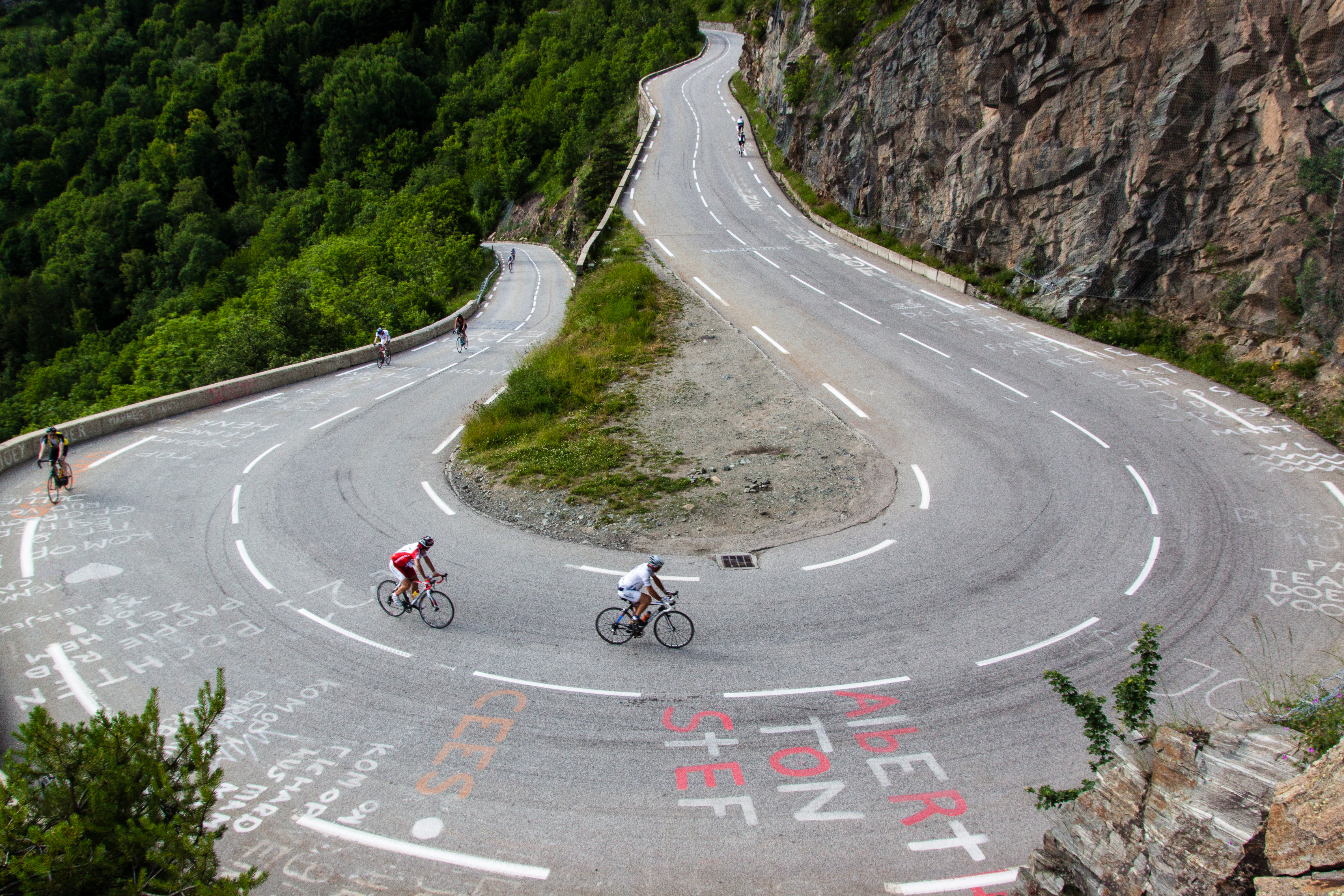
The Tour's mountain: the first summit finish in race history in 1952, won by Coppi, and Dutch property from 1976 on, with eight of the first fourteen wins and bend 7 permanently Dutch Corner. Twenty-one hairpins each carry a stage winner's name; Pantani's 37:35 stood as the reference for nearly three decades until Pogačar's 35:27 in 2026.
 Robbie Shade
 Robbie Shade
 McSmit
 filip bossuyt
Loading rider experiences…
Download GPX
Navigate to the foot
Where it bites
Steepest 500 m: 12.0% (km 7–7.4).
What it’s like to ride
Twenty-one numbered bends count down from 21 at the bottom to 1 at the top, each signed with the name of a Tour stage winner, so you always know exactly what is left. The hard part comes first: the six bends up to La Garde average around 11%, and the 200 m of 6.5 to 7% through the hamlet at bend 16 is the first place you can drink and reset. After that the road settles to a steady 8 to 9% that feels almost kind by comparison, past the church of Saint-Ferréol on its short flat at bend 7, the corner the Dutch take over during the Tour. Fill a bottle at the fountain by the Huez cemetery at 1390 m, because the climb gets very hot in summer with the sun coming back off the tarmac and the walls. The bends from 5 to 0 are as hard as anything at the bottom, then the gradient drops to 5-6% for the last three kilometres, the Grandes Rousses massif ahead of you, through the tunnel at Vieil Alpe and out onto a flat run into the resort, where there are cafés over the final kilometre.
Common questions
- How long and steep is Alpe d'Huez?
- Alpe d'Huez is a 13.9 km cycling climb averaging 8.0% (+1111 m), rising from 718 m to 1828 m in French Alps.
- Where is Alpe d'Huez steepest?
- The steepest 500 m averages 12.0%, between km 7 and km 7.4 of the climb.
- How many hairpins does Alpe d'Huez have?
- Alpe d'Huez has 22 hairpin bends, counted from the road's map geometry (a hairpin here means at least 150 degrees of turning completed within 150 metres of road). Painted corner numbers on some climbs count gentler bends too, so the two figures can differ.
13.9 km · +1111 m · 8.0% avg · ~12.0% max · 718 → 1828 m · 22 hairpins