

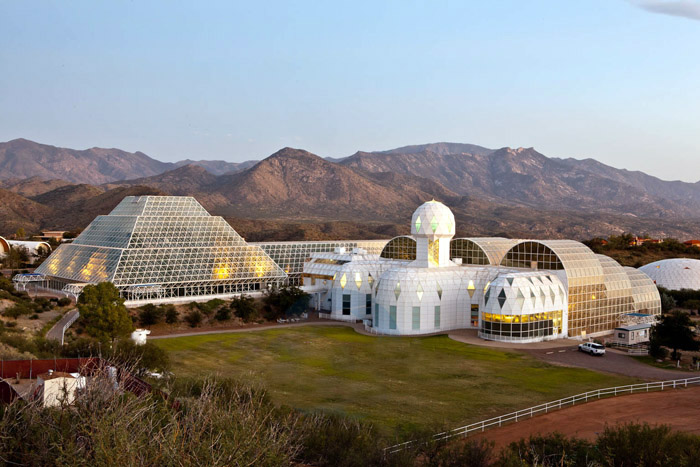


Biosphere 2
Landmark · Tucson & the Sky Islands
Checked
A 3.14-acre enclosed ecosystem built 1987–1991 to test whether humans could survive in a sealed, self-sustaining environment, research aimed at eventual space habitats. The largest closed ecological system ever created, it contains multiple biomes, agricultural areas, and living quarters, designed to study how humans, farming, technology, and nature interact.
In September 1991 eight scientists, dubbed "biospherians," sealed themselves inside for a planned two-year test of whether humans could survive entirely off a self-contained world. Conditions deteriorated fast: crops underperformed, the crew lived on rationed, near-starvation diets, and the group split into two factions who eventually stopped speaking to each other. They stayed sealed in for the full two years regardless, emerging in September 1993. A second mission the following year collapsed within months amid a management takeover and infighting, and the original vision was abandoned soon after. Columbia University ran it as a research station through the rest of the 1990s, and the University of Arizona has managed it since 2007, opening the sealed world to public tours and ongoing climate research.
What you see
A sprawling glass and white steel complex rises out of the desert scrub in the Santa Catalina foothills, its biomes joined to two huge white domed "lungs" that expand and contract to keep the sealed air pressure stable.
historysciencelandmarkarchitecture