Camphin-en-Pévèle
Roubaix
Elevation is drawn to the same scale on every segment, so a level sector looks level. The bands beneath the line are surface, not gradient.
Route and surface read from OpenStreetMap, elevation from satellite data — approximate.
Camphin-en-Pévèle is a 1.8 km cobbled sector in Roubaix, essentially level (+1 m over its full length). It is cobbled throughout.
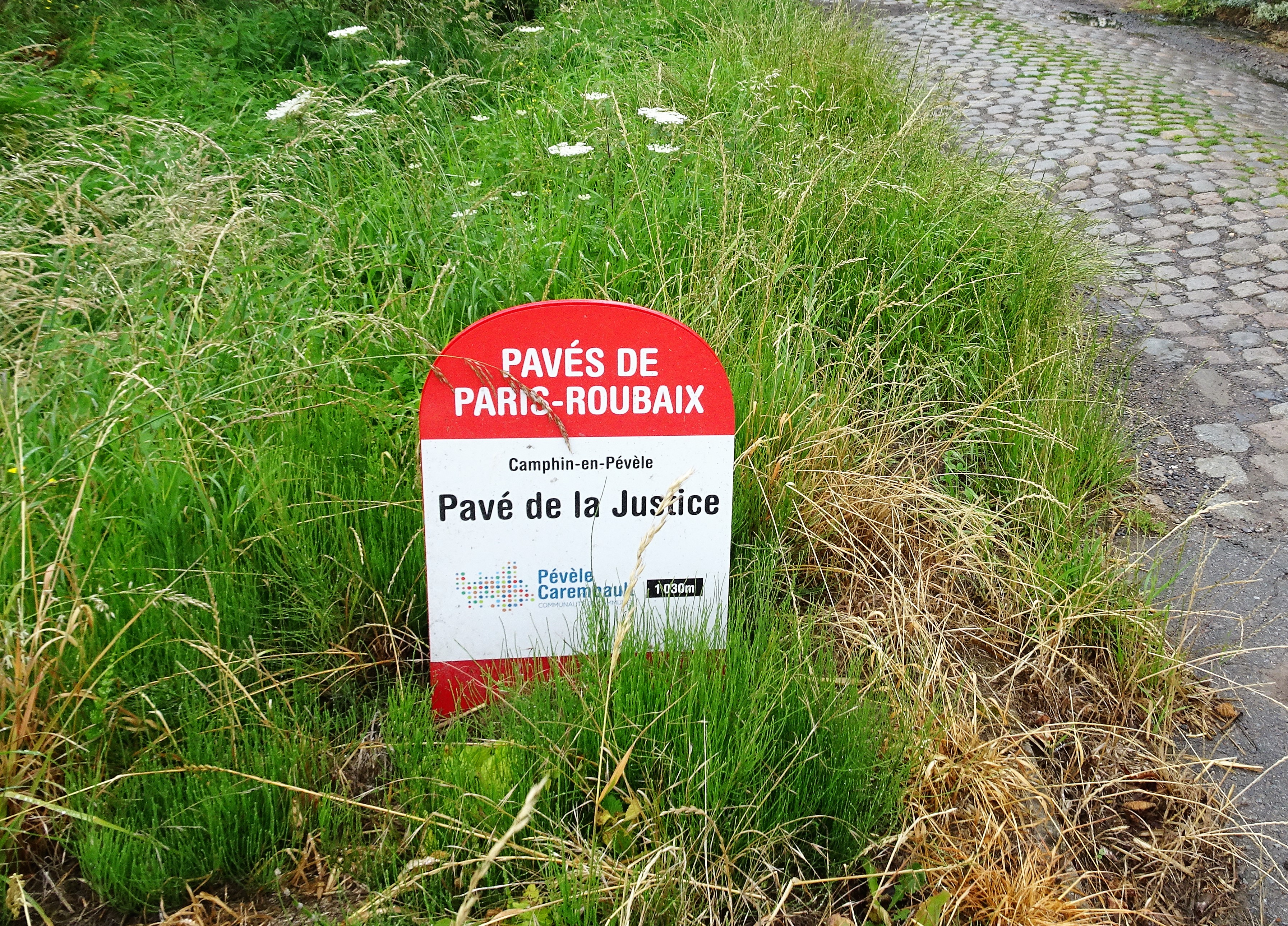
Four stars, 1,800 metres, the last cobbles before the Carrefour de l'Arbre, and since 2023 the sector that carries Eddy Merckx's name. It follows the line of a Roman road, and it is where Dylan van Baarle launched his winning attack in 2022, 438 watts across the stones to finish alone in Roubaix.
 Velvet, CC BY-SA 4.0
 Rz98, CC BY-SA 4.0
 PIERRE ANDRE LECLERCQ, CC BY-SA 4.0
 Pierre André Leclercq, CC BY-SA 4.0
 Rz98, CC BY-SA 4.0
 Pierre André Leclercq, CC BY-SA 4.0
Loading rider experiences…
Download GPX
Navigate to the start
History
Camphin-en-Pévèle entered the Paris-Roubaix route in 1980, late enough that Eddy Merckx, who won the race for the last time in 1973, never raced over it. The road is the rue de la Justice, still called the pavé de la Justice locally, and a plaque at the entry marks it as the line of the Roman road from Tournai to Cassel by Estaires. It runs 1,800 metres at four stars in the current ASO roadbook, sector 5, reached with about 20 km left and with the Carrefour de l'Arbre next, and it turns through a right angle halfway along. Philippe Gilbert went clear 23 km from Roubaix in 2019 with Peter Sagan and Nils Politt following, and Sep Vanmarcke and Yves Lampaert clawed their way back only at the end of this sector; in 2022 Dylan van Baarle attacked here with 19 km to go, averaging 438 watts at 41 km/h across the 1.8 km to drop Matej Mohorič and Lampaert, and finished alone by 1:47. In the 2025 women's race Franziska Koch twice opened a gap on Pauline Ferrand-Prévot on these stones before the Frenchwoman came back and rode on to win. On 6 April 2023 the sector was renamed for Merckx and a stele unveiled in his presence, an initiative of Les Amis de Paris-Roubaix, the association that exists to stop the pavé being tarmacked: the sector closest to the Belgian border was chosen for him, and he became the sixth rider with a sector in his name.
What it’s like to ride
Camphin-en-Pévèle leaves the D93 on a sharp left at the southern edge of the village and the pavé starts at once: 1,800 metres of it, almost dead flat, past farm buildings and then out into open fields with Belgium right there over the ploughing. The first kilometre is why it holds four stars, loose small stones and dust sitting on pavé that is irregular on the crown and irregular on the verge alike, so the usual answer of finding a line and holding it does not work here; some of it is well laid, some is broken up badly by the farm traffic that uses the lane, and there is no continuous smooth strip to hide on, which is why it rewards raw power over craft. A right-angle turn then sends you back toward Camphin and the second half is worse than the first, and the run-in gives you nothing before it: over three kilometres of tarmac transition, the last of it fully open to the wind, so you arrive already working. Wet, it is a place people fall rather than simply slow down: Guillaume Boivin's rear wheel went from under him here in the 2021 edition, 20 km from Roubaix, and the camera motorbike behind him crashed avoiding him. Plainly, this is one of the ones that hurts. Outside race day it is an ordinary public farm lane, Rue de la Justice and then Chemin du Quennelet, open to ride any day of the year, and riders who know it recommend tubeless; the Carrefour de l'Arbre begins about a kilometre of road after the exit.
Surface and what to expect
Cobbled throughout.
Cobbleskm 0.0–1.8
Common questions
- How long is Camphin-en-Pévèle?
- Camphin-en-Pévèle is a 1.8 km cobbled sector in Roubaix, essentially level (+1 m over its full length). It is cobbled throughout.
- What is the surface like on Camphin-en-Pévèle?
- Camphin-en-Pévèle is cobbled throughout, measured from OpenStreetMap surface tags along the route.
- Is Camphin-en-Pévèle flat?
- Effectively, yes. It gains 1 m across 1.8 km — an average of 0.2%.
1.8 km · level · +1 m · 1.8 km cobbled