Hornaing à Wandignies-Hamage
Roubaix
Elevation is drawn to the same scale on every segment, so a level sector looks level. The bands beneath the line are surface, not gradient.
Route and surface read from OpenStreetMap, elevation from satellite data — approximate.
Hornaing à Wandignies-Hamage is a 3.6 km cobbled sector in Roubaix, essentially level (+2 m over its full length). It is cobbled throughout.
The longest sector in Paris-Roubaix at 3.7 km, four stars, renamed for John Degenkolb in 2020 after his appeal saved the junior race. It is where Lizzie Deignan went clear on the first cobbles of the first Paris-Roubaix Femmes in 2021 and rode the last 80 km alone.
 Pierre André Leclercq, CC BY-SA 4.0
 Renhour48, CC0
 Pierre André Leclercq, CC BY-SA 4.0
 Pierre André Leclercq, CC BY-SA 4.0
 Renhour48, CC0
 Pierre André Leclercq, CC BY-SA 4.0
Loading rider experiences…
Download GPX
Navigate to the start
History
Cobbles at Hornaing entered Paris-Roubaix in 1966, when the organisers pushed the route east to find pavé that was disappearing elsewhere and the first of the new sections turned up here. At 3.7 km it is the longest sector in the race, carries four stars, has been numbered 17 in recent editions and is known locally as the water tower sector. Its most decisive day came on 2 October 2021, when Lizzie Deignan attacked on it as the first cobbles of the inaugural Paris-Roubaix Femmes, went clear before the television pictures had even started, and rode the last 80 km alone to beat Marianne Vos by over a minute. The Tour de France took the whole sector the other way, from Wandignies-Hamage to Hornaing, on stage 5 in 2014, the sixth of nine cobbled sections that day. On 10 February 2020, at Erre at the foot of the water tower, the road was renamed for John Degenkolb, the 2015 winner, whose crowdfunding appeal had raised more than 10,000 euros in about a day to save Paris-Roubaix Juniors in 2019: the Hornaing cycling club under its president Vincent Talmasse drove the idea, and steles were unveiled at Hornaing and at Erre. Keeping the stones there is the Département du Nord's work alongside Les Amis de Paris-Roubaix, and a stretch of the RD 313 between Erre and Hornaing was rebuilt for around 200,000 euros, the setts lifted one by one, the road structure remade beneath them and every stone relaid.
What it’s like to ride
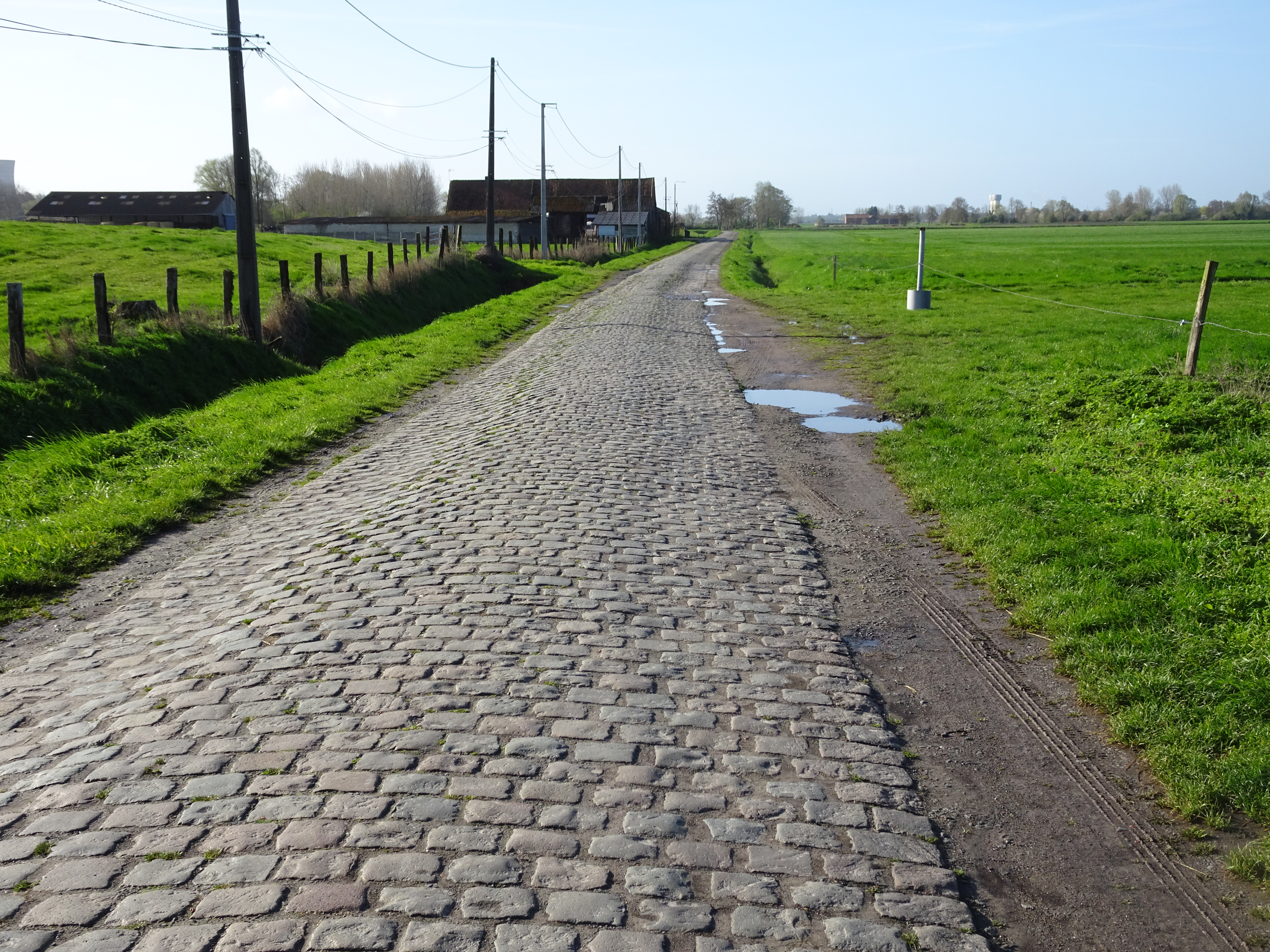
The longest sector in Paris-Roubaix, 3.7 km of four-star pavé, and it is the length rather than any one stretch of it that does the damage: recon reports call it more tiring mentally than physically, a sector whose end never arrives. The first 800 m out of Hornaing is the rougher half, big stones and a few bends, a level crossing on the cobbles, gravel and broken tarmac either side instead of a clean verge, then a few metres of asphalt and a hard right at the twin water towers. From there it runs almost 2.9 km straight and flat to Wandignies-Hamage, losing six metres in total, two faint bends and nothing to break the wind. The stones on that half are noticeably smaller and the pavé is in decent condition throughout, but the crown stands higher and the strips either side of it are uneven and unpredictable enough to puncture you, so the top of the road is the line. Not the hardest sector of the race, and it still empties the legs before the ones that are. It is public road, the D343 then the D130, ridable any day, and the Paris-Roubaix Challenge takes amateurs over all of it.
Surface and what to expect
Cobbled throughout.
Cobbleskm 0.0–3.6
Common questions
- How long is Hornaing à Wandignies-Hamage?
- Hornaing à Wandignies-Hamage is a 3.6 km cobbled sector in Roubaix, essentially level (+2 m over its full length). It is cobbled throughout.
- What is the surface like on Hornaing à Wandignies-Hamage?
- Hornaing à Wandignies-Hamage is cobbled throughout, measured from OpenStreetMap surface tags along the route.
- Is Hornaing à Wandignies-Hamage flat?
- Effectively, yes. It gains 2 m across 3.6 km — an average of 0.1%.
3.6 km · level · +2 m · 3.6 km cobbled