Eikenberg
Flanders
Gradient by colour: under 3% 3–6% 6–9% 9%+
Stats computed from OpenStreetMap and satellite elevation data — approximate.
Eikenberg is a 1.0 km cycling climb averaging 5.3% (+53 m), rising from 25 m to 78 m in Flanders.
In the Tour of Flanders 48 times since 1956, and a protected monument since 1995, the heritage listing calling it one of the last surviving examples of this kind of stone paving. The berg that rides like a Roubaix sector: a kilometre of tightly packed cobbles where length, not gradient, does the work.
 Anthospace
 LimoWreck
 LimoWreck
 Van der Linden, Geert
Loading rider experiences…
Download GPX
Navigate to the foot
Where it bites
Steepest 250 m: 9.9% (km 0.4–0.6).
Road: 0.8 km of cobbles, the rest asphalt
| section | to | avg |
|---|
| 0–250 m | 37 m | 6.6% |
| 250–500 m | 53 m | 7.0% |
| 500–750 m | 73 m | 6.4% |
| 750–1000 m | 78 m | 1.9% |
What it’s like to ride
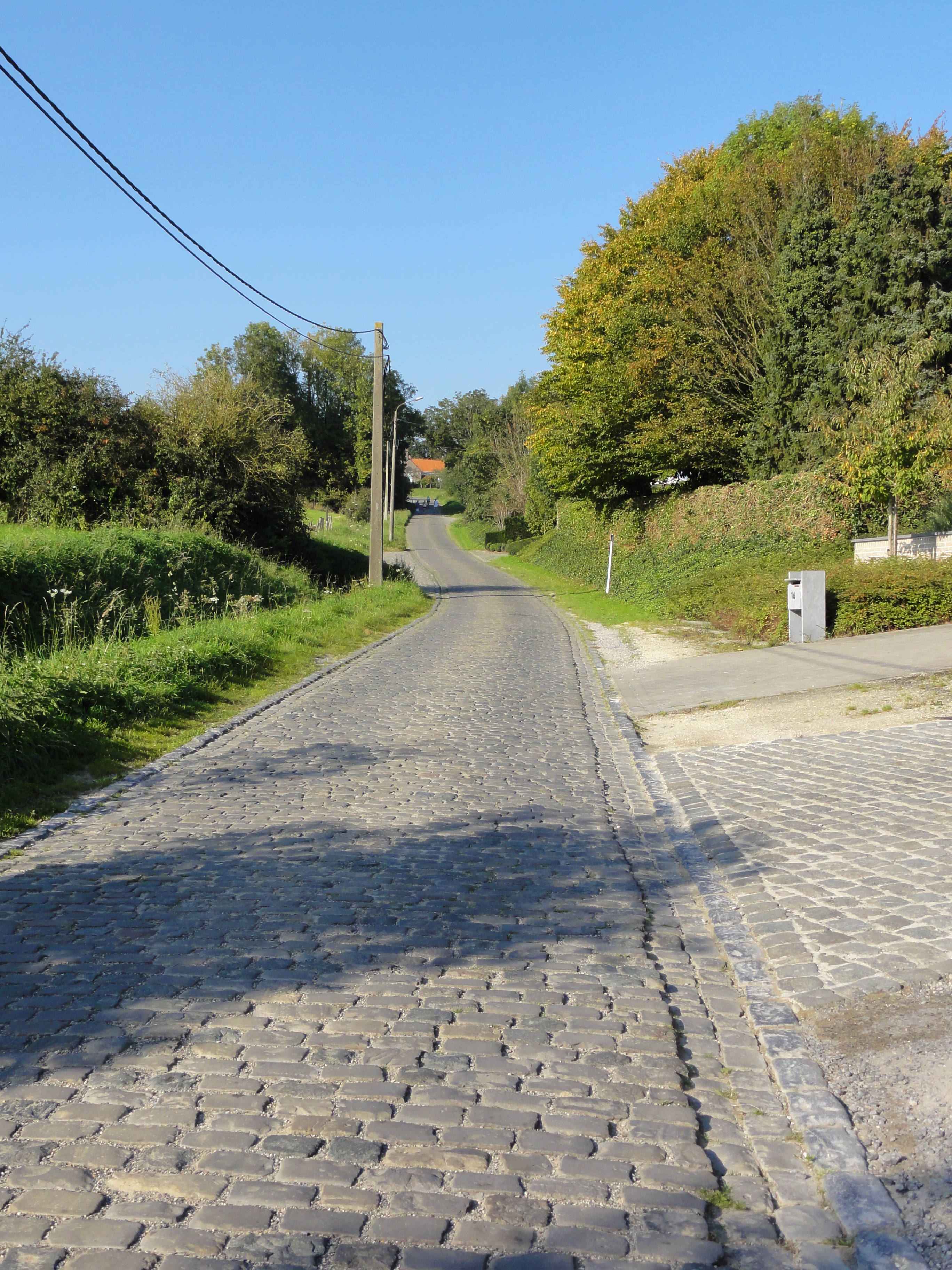
The Eikenberg climbs a little over a kilometre of cobbles out of the Maarke brook valley to the top at Kerzelare, a few kilometres east of Oudenaarde, averaging around 5% and touching 10% at its steepest. The setts are smooth and tightly packed, so nothing on it needs dodging, and the wide turn at the foot lets you arrive carrying speed: it is possible to stay in the big ring the whole way up. Length is the difficulty rather than gradient, because the cobbles run on with no real let-up, and at that shallow a pitch the climb takes on the character of a Paris-Roubaix cobble sector. Thin strips of asphalt along the edges give brief relief, and about halfway up there is a longer asphalt section on the left. The road has been a protected monument since 1995, and it has appeared in the Tour of Flanders forty times since 1956, usually early in the race, as well as in Omloop Het Nieuwsblad.
History
The cobbles of the Eikenberg climb out of the Maarkebeek valley in Maarkedal to the Oudenaarde to Brakel road at Kerselare, and they have been a protected monument since 30 March 1995, the heritage listing calling the road one of the last surviving examples of this kind of stone paving and singling out its longitudinal profile, foundation and edging as industrial archaeology. The Tour of Flanders first came here in 1956 and has used the berg 48 times through 2025, almost every year from 1974 onward; the 2003 edition skipped it for roadworks and sent the race up the neighbouring asphalt of the Ladeuze instead. Its slot in the route keeps moving: third climb of the day between the Kortekeer and the Wolvenberg from 2014 to 2018, second climb between the Oude Kwaremont and the Wolvenberg in 2025. Omloop Het Volk, now Omloop Het Nieuwsblad, took it 25 times between 1979 and 2013, and it also appears in the E3, Dwars door Vlaanderen and the Driedaagse van De Panne. Subsidence in the roadbed forced a full relaying of the stones, a 2.7 million euro job finished on 21 February 2025, the day before the Omloop came through, with follow cars kept off the 3.5 m wide road while the grouting hardened. Amateurs ride the same surface on the We Ride Flanders sportive and on the red loop of the signposted Ronde van Vlaanderenroute.
Common questions
- How long and steep is Eikenberg?
- Eikenberg is a 1.0 km cycling climb averaging 5.3% (+53 m), rising from 25 m to 78 m in Flanders.
- Where is Eikenberg steepest?
- The steepest 250 m averages 9.9%, between km 0.4 and km 0.6 of the climb.
- Is Eikenberg cobbled, and for how far?
- Yes. 0.8 km of Eikenberg's 1.0 km are laid in sett or cobblestone (0.8 km of cobbles, the rest asphalt), measured from OpenStreetMap surface tags along the climb.
1.0 km · +53 m · 5.3% avg · ~9.9% max · 25 → 78 m